Lighten up: the power of water and bleach

liter of light

This concept has been introduced a couple of years ago, the result however is very impressive so I’d like to put it in the ‘spotlight’ again. In 2002 Alfredo Moser in Brazil came up with the idea to use bottles filled with water and bleach as a light source. Nine years later in the Philippines Illac Diaz from the MyShelter Foundation and students from MIT further developed the concept. They made the ´solar bulbs´ available to the public by means of a “local entrepeneur” business model. This approach combined two great initiatives: providing light in dwellings without electricity and creating jobs for locals. Within a year over 200.000 bottle bulbs were installed. The goal of the MyShelter Foundation is to light up 1 million homes by the end of 2015. At the moment the solar bottles are being installed in over 15 countries.

The concept of the solar bottle bulb is fairly simple: a used plastic bottle is filled with a mixture of water and a little chlorine – to keep the water clean and transparent. The bottle is sealed and pushed through a galvanized steel sheet that serves as a metal lock to prevent the bottle from slipping. It is then embedded into a corrugated iron roof. Only a small part of the bottle is left outside while the rest protrudes into the dwelling. The sunlight that enters the inside of the bottle becomes omni-directional through the refractive qualities of the water. The effect: an amount of light equal to that produced by a 40-60 Watt electric light bulb.

More info at: Liter of Light.
Active facade – to protect, collect and redirect

WarmteWinWoning_JanssendeJongBouw

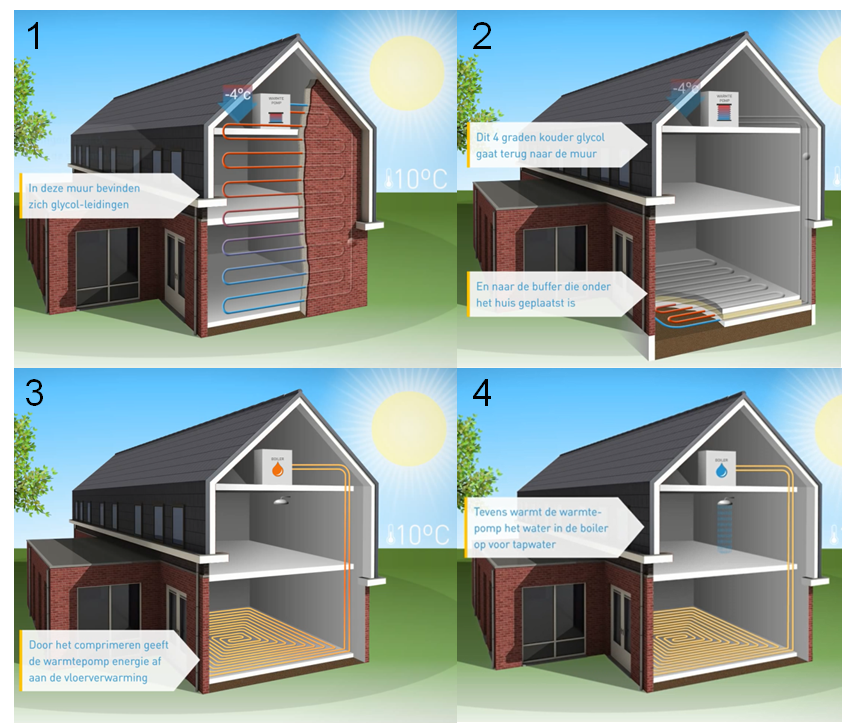
In October 2013 the first ‘WarmteWinWoning’ (free translation: heat-gain-dwelling) has been completed in the Netherlands. A so called ‘WarmteWinMuur’ (heat-gain-facade) has been applied which consists of a prefabricated concrete wall with integrated glycol filled piping. Heat from solar radiation and by convection from the outdoor air is collected by the glycol in the facade and led to a heat pump (1). The heat pump compresses the glycol and the emanating heat is extracted, hereby lowering the temperature of the glycol by approximately 4 degrees. The cooled glycol then is transported to a concrete, thermal buffer underneath the ground floor where it is stored and/or sent back into the wall where it will be reheated (2).  The heat gained through compression is transferred to a low temperature floor heating system (3) and is used to heat water in a boiler that supplies hot tap water (4). The system is controlled by a smart thermostat that ensures a comfortable indoor climate. Because the system responds slow to changes, the temperature is held constant both day and night. According to the developers, for optimal functioning the size of the active facade should be at least 20% of the gross floor area of the dwelling.

The concept has been developed since 2003 when it was tested in a holiday home. In 2008 it has been applied in a daycare centre. Both projects are designed with concrete walls. To make the concept suitable for Dutch housing, where customers prefer the look of brick facades instead of concrete, a prefabricated concrete wall with brick cladding has been developed. In collaboration with Eindhoven University of Technology the wall has been optimized. Because of the temperature changes in the wall, extra dense brick tiles have been firmly attached to the concrete to avoid damage in case of thermal stress. The developers claim that the dwellings can be built in 7 (!) weeks and that the energy bill, when in use, can be up to 45% lower than the bill of a dwelling with a conventional installation concept. More info at Janssen de Jong Bouw.

Highly efficient, ultra thin photovoltaic cells

PV TUDelft

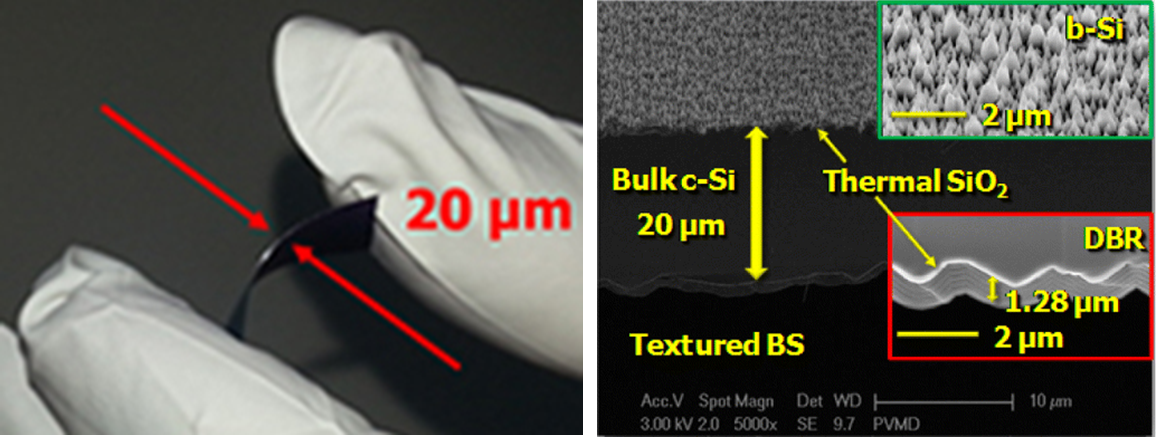
At Delft University of Technology (DUT) researchers have been able to increase the efficiency of ultrathin crystalline silicon solar cells.  They have developed an advanced metal-free light trapping scheme for crystalline silicon wafers. A nano-texture known as black-silicon has been applied at the front side of the silicon wafers. A random pyramidal texture coated with a photonic Dielectric Back Reflector (designed to exhibit maximal and omni-directional internal reflectance) has been implemented at the rear side. The result: absorption up to 99.8% of the theoretical classical absorption limit in the broad light spectrum from 400 to 1200 nm can be achieved. More info at DUT.