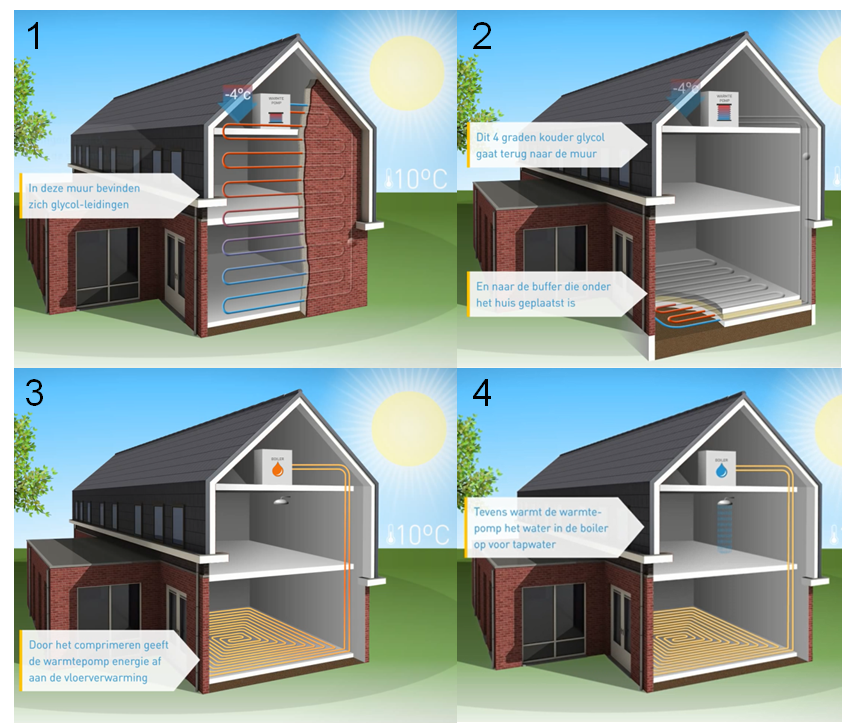
In October 2013 the first ‘WarmteWinWoning’ (free translation: heat-gain-dwelling) has been completed in the Netherlands. A so called ‘WarmteWinMuur’ (heat-gain-facade) has been applied which consists of a prefabricated concrete wall with integrated glycol filled piping. Heat from solar radiation and by convection from the outdoor air is collected by the glycol in the facade and led to a heat pump (1). The heat pump compresses the glycol and the emanating heat is extracted, hereby lowering the temperature of the glycol by approximately 4 degrees. The cooled glycol then is transported to a concrete, thermal buffer underneath the ground floor where it is stored and/or sent back into the wall where it will be reheated (2). The heat gained through compression is transferred to a low temperature floor heating system (3) and is used to heat water in a boiler that supplies hot tap water (4). The system is controlled by a smart thermostat that ensures a comfortable indoor climate. Because the system responds slow to changes, the temperature is held constant both day and night. According to the developers, for optimal functioning the size of the active facade should be at least 20% of the gross floor area of the dwelling.
The concept has been developed since 2003 when it was tested in a holiday home. In 2008 it has been applied in a daycare centre. Both projects are designed with concrete walls. To make the concept suitable for Dutch housing, where customers prefer the look of brick facades instead of concrete, a prefabricated concrete wall with brick cladding has been developed. In collaboration with Eindhoven University of Technology the wall has been optimized. Because of the temperature changes in the wall, extra dense brick tiles have been firmly attached to the concrete to avoid damage in case of thermal stress. The developers claim that the dwellings can be built in 7 (!) weeks and that the energy bill, when in use, can be up to 45% lower than the bill of a dwelling with a conventional installation concept. More info at Janssen de Jong Bouw.
 brightbuilding