
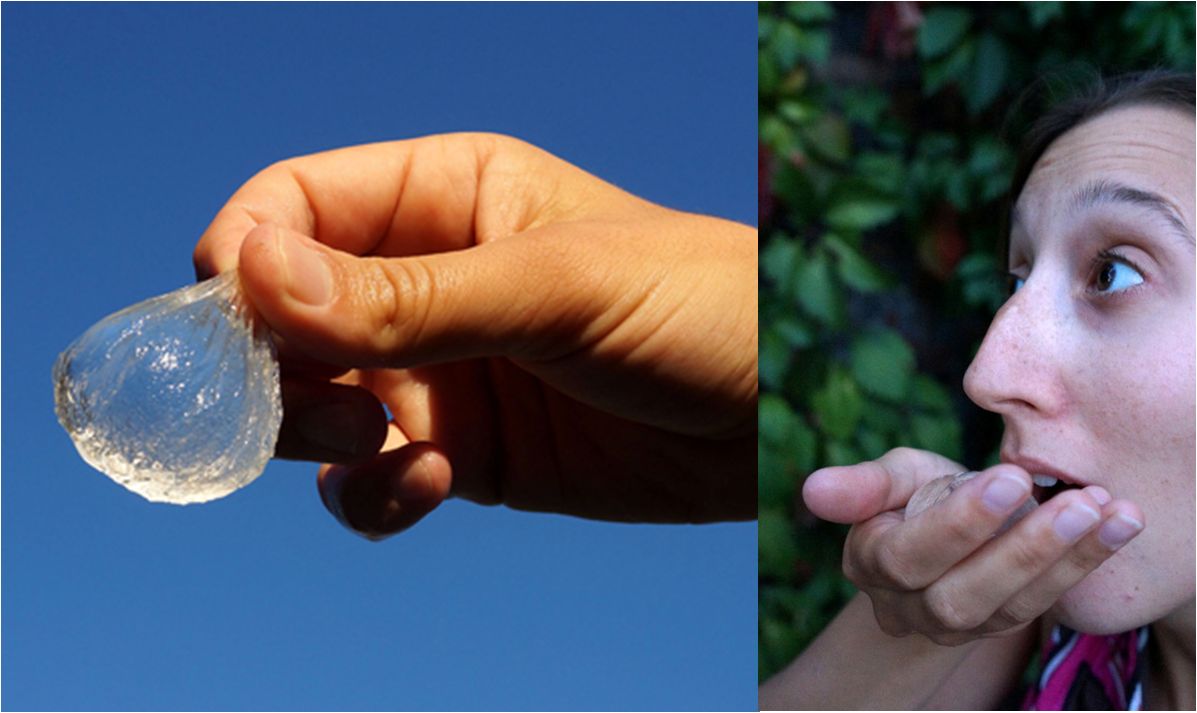
The Ooho: ‘edible’ water

The Ooho

Designers of studio Skipping Rocks Lab have created an edible water ‘bottle’ using a technique called spherification. This technique originates from the 1940s and has been reintroduced in 2003 by El Bulli chef Ferran Adria. To create the water bottles or Ooho’s as they have been named, water is frozen and the ice is placed into a solution containing calcium chloride and brown algae. When the ice meets the solution a thin, flexible and edible skin is created. The skin consists of a double membrane, which makes it possible to dispose of the (less hygienic) outer membrane before consuming the Ooho.  The inner membrane can be consumed together with the water or be thrown away ‘sustainably’: the membrane is biodegradable. Ooho’s are easy and cheap to create, you can even make them in your own kitchen. To provide the Ooho to as many people as possible the team is planning to make the recipe open source. Next to the environmental impact also the financial impact is promising. Producing an Ooho is cheaper than producing a conventional water bottle: the producers claim that the costs are 2 versus 10 cents. At the moment the team works on improving the user friendliness of the design. If a feature like a lid would be added (it is not yet possible to close an opened Ooho) and Ooho’s could be consumed more efficiently, the days of old fashioned water bottles might be counted. More info and a movie here.


 

Thinking outside the rectangle

Hazukashi_Alts Design

Sometimes a project brings a kind of innovation that is not groundbreaking. It does not reduce our impact on the environment or provides new medicine to cure diseases. Sometimes a project just makes us look at our daily environment in a different way. Looking at things in a different way however is how groundbreaking innovations are born. So take a minute every once in a while to observe the details in the world around you, find the peculiarities, reflect, and see where it may bring you :). More info at Alts Design Office.

Emotional equations

608px-Euler's_formula.svg

Researchers of University College London found that when mathematicians were presented with an equation they perceived as beautiful, their brain showed increased activity in the A1 field of the medial orbitofrontal cortex. Surprising is that the orbitofrontal cortex is associated with emotion and that this particular region in previous tests has shown to be correlated with emotional responses to visual and musical beauty. This result is amplified by the fact that most mathematicians agreed on which equations were beautiful. A control group of people with little in depth knowledge of math did not show such a pattern, their preferences turned out to be rather random.

Apparently emotion can be guided by ratio. Interesting thought, but logical as well. We perceive (near) symmetrical faces as more beautiful than imbalanced faces. Regarding reproduction this is a rational choice because evolution taught us that symmetry indicates a smaller chance of genetic defects. Favouring symmetry increases our chance of survival. The same conclusion might apply to the appreciation of elegant mathematical equations: they have the potential to bring mankind to the next level. This raises another question: what would be the contribution of Mozart’s ‘Eine Kleine Nachtmusik’, Rembrandt’s ‘Night Watch’ or Ustad Isa’s ‘Taj Mahal’ to evolution? More info on the study at Scientific American.

Smog Ring: “turning dust into diamonds”

17iht-acaj-diamond17-superJumbo

Surprised by the level of smog he experienced in Beijing, Daan Roosegaarde set a goal to create clean parks in Beijing. To achieve this Studio Roosegaarde has been working on an electronic vacuum cleaner to remove smog particles from the sky. To raise aditional awareness for the smog problem the collected dust will be used to create two types of ‘smog’ rings. The regular type will contain a milimeter cube of compressed dust, created with a hand-operated press, which symbolizes the cubic kilometer of smog that has been cleared to create it. The dust used for the limited edition version will be compressed enough to turn into something very similar to a diamond while still retaining some of it’s characteristic pigment. As Roosegaarde puts it: when buying a ring, “you are buying a cubic kilometer of clean Beijing air”. More info at Studio Roosegaarde.