
Emotional equations

608px-Euler's_formula.svg

Researchers of University College London found that when mathematicians were presented with an equation they perceived as beautiful, their brain showed increased activity in the A1 field of the medial orbitofrontal cortex. Surprising is that the orbitofrontal cortex is associated with emotion and that this particular region in previous tests has shown to be correlated with emotional responses to visual and musical beauty. This result is amplified by the fact that most mathematicians agreed on which equations were beautiful. A control group of people with little in depth knowledge of math did not show such a pattern, their preferences turned out to be rather random.

Apparently emotion can be guided by ratio. Interesting thought, but logical as well. We perceive (near) symmetrical faces as more beautiful than imbalanced faces. Regarding reproduction this is a rational choice because evolution taught us that symmetry indicates a smaller chance of genetic defects. Favouring symmetry increases our chance of survival. The same conclusion might apply to the appreciation of elegant mathematical equations: they have the potential to bring mankind to the next level. This raises another question: what would be the contribution of Mozart’s ‘Eine Kleine Nachtmusik’, Rembrandt’s ‘Night Watch’ or Ustad Isa’s ‘Taj Mahal’ to evolution? More info on the study at Scientific American.
Home for life: an intelligent new species

home for life edited

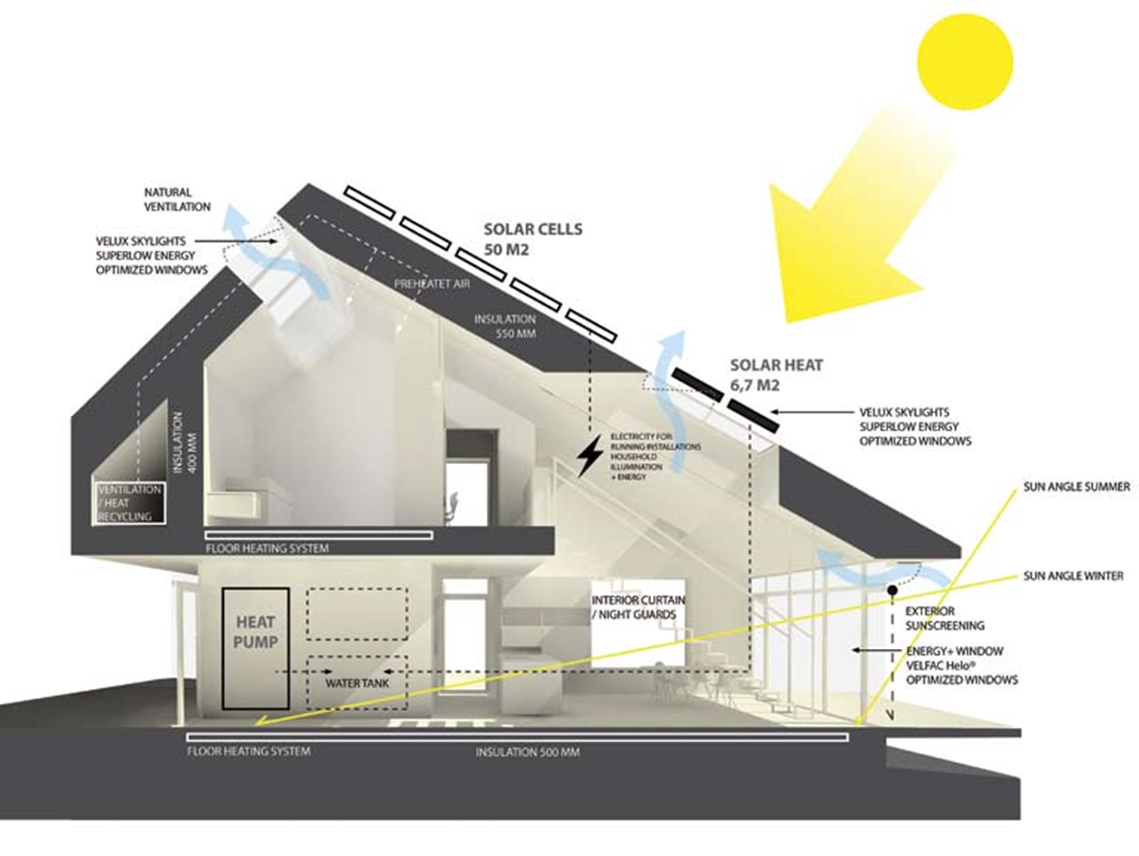
One of the most interesting requests I received while working in building physics has been to evaluate the energy efficiency of the project ‘Home for Life’ according to Dutch energy standards. This dwelling is an example of the active house strategy: the dwelling is energy efficient (even produces more than it needs), creates a comfortable living environment and relates to the local context. A combination of sensors that register heat, CO2 and humidity in all rooms, an outdoor weather station and an intelligent control system ensure a comfortable indoor climate. To optimize energy efficiency a hybrid ventilation system has been applied: the house is naturally ventilated during summer and mechanically, with incorporated heat recovery, during winter. During summer this means saving energy that otherwise would be needed to operate fans. Some more extraordinary measures: when the indoor temperature exceeds the programmed values, windows in both facade and roof automatically open to create a ‘chimney effect‘ which helps reduce the temperature. And automatically controlled solar shades not only exclude excessive heat during hot (summer) days, but are also used to insulate the facade during cold nights to keep heat inside. When focussing on energy efficiency in buildings, designers generally aim to maximize the insulation of  the skin by minimizing the total amount of window area (the weakest link). The quality and amount of daylight within the ‘Home for Life’ however is impressive: over twice as much window area is implemented compared to a standard dwelling. The intelligent building concept manages to enable an exceptionally bright indoor atmosphere  while maintaining a high level of comfort within the dwelling. More info at Active House.

Smog Ring: “turning dust into diamonds”

17iht-acaj-diamond17-superJumbo

Surprised by the level of smog he experienced in Beijing, Daan Roosegaarde set a goal to create clean parks in Beijing. To achieve this Studio Roosegaarde has been working on an electronic vacuum cleaner to remove smog particles from the sky. To raise aditional awareness for the smog problem the collected dust will be used to create two types of ‘smog’ rings. The regular type will contain a milimeter cube of compressed dust, created with a hand-operated press, which symbolizes the cubic kilometer of smog that has been cleared to create it. The dust used for the limited edition version will be compressed enough to turn into something very similar to a diamond while still retaining some of it’s characteristic pigment. As Roosegaarde puts it: when buying a ring, “you are buying a cubic kilometer of clean Beijing air”. More info at Studio Roosegaarde.

Highly efficient, ultra thin photovoltaic cells

PV TUDelft

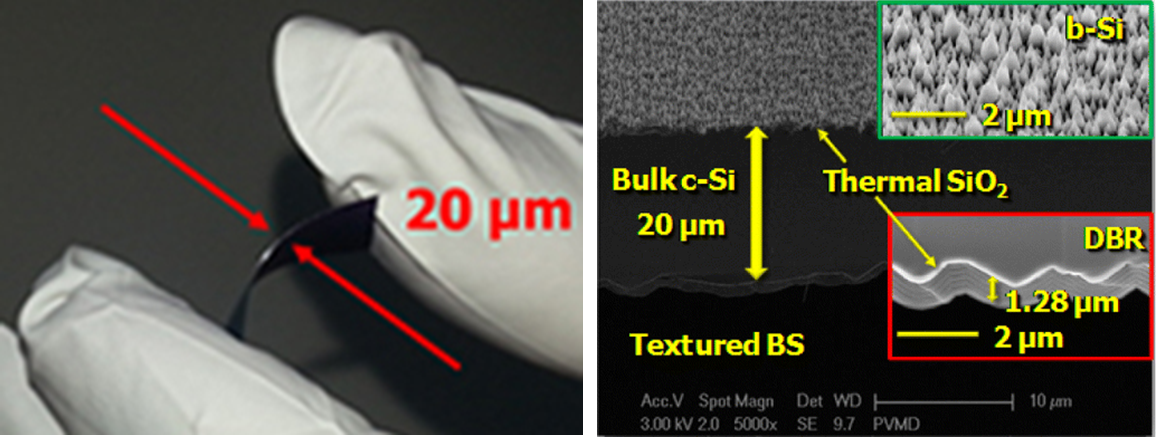
At Delft University of Technology (DUT) researchers have been able to increase the efficiency of ultrathin crystalline silicon solar cells.  They have developed an advanced metal-free light trapping scheme for crystalline silicon wafers. A nano-texture known as black-silicon has been applied at the front side of the silicon wafers. A random pyramidal texture coated with a photonic Dielectric Back Reflector (designed to exhibit maximal and omni-directional internal reflectance) has been implemented at the rear side. The result: absorption up to 99.8% of the theoretical classical absorption limit in the broad light spectrum from 400 to 1200 nm can be achieved. More info at DUT.